

“Broken Vessels” by Artist Cindy Bernhard
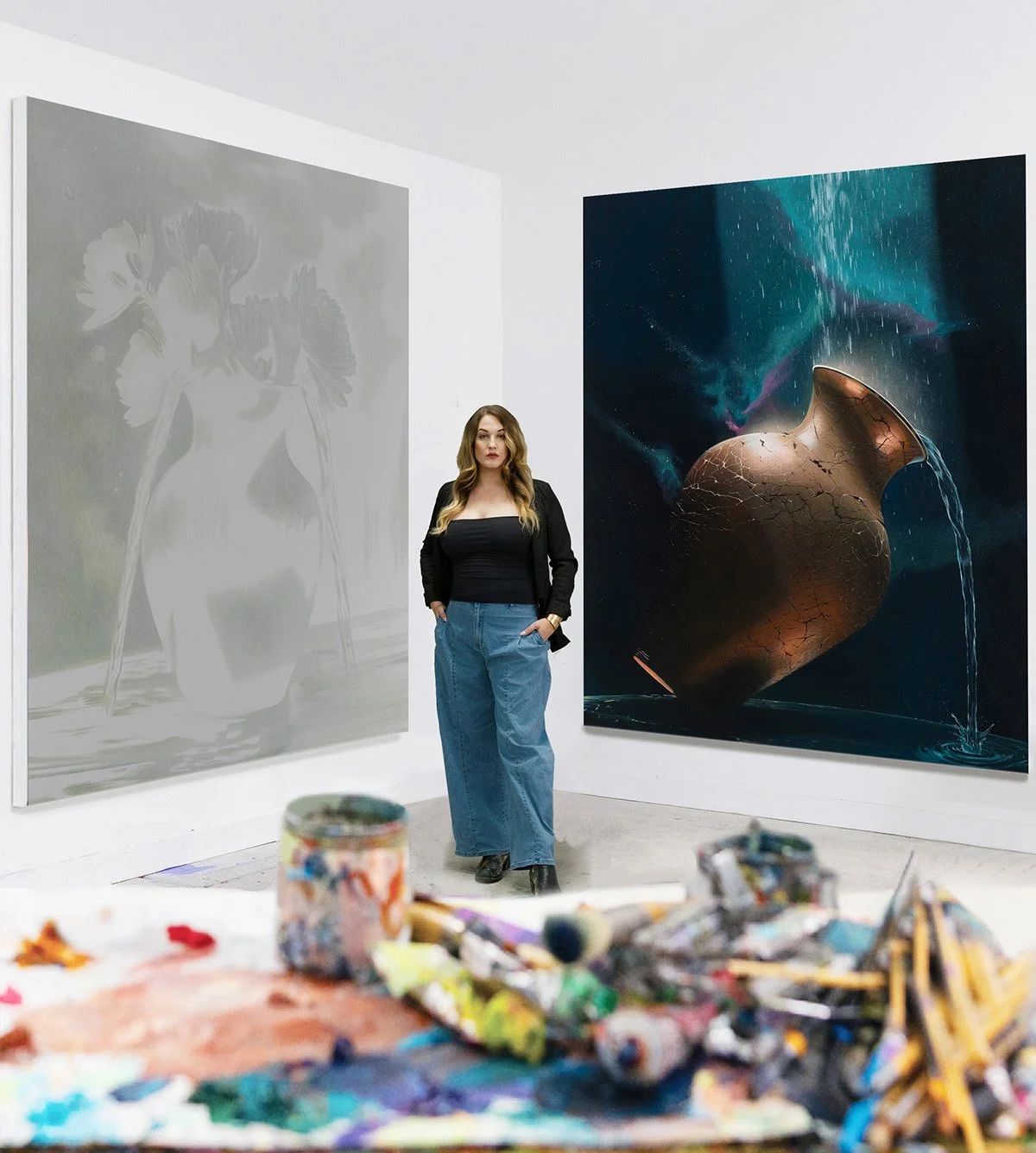
A new body of paintings by Chicago-based artist Cindy Bernhard. Bernhard received her BFA from the American Academy of Art in Chicago in 2011 and her MFA from Laguna College of Art and Design in 2014. Her work explores themes of spiritual rupture, transcendence, and the relationship between the human body and the divine. At the center of her latest exhibition, “Broken Vessels”, is the metaphor of the body as a container for spirit and belief. Drawing from archetypal associations between gold and divinity, Christian mysticism and contemporary existential anxiety, Bernhard’s monumental six-foot paintings depict fractured golden forms that stand in for humanity itself—wounded, imperfect, yet still capable of transformation.
Click here to read the full article.
_________________________________________________________________________________________

Cindy Bernhard
Broken Vessels
June 4 - July 11, 2026
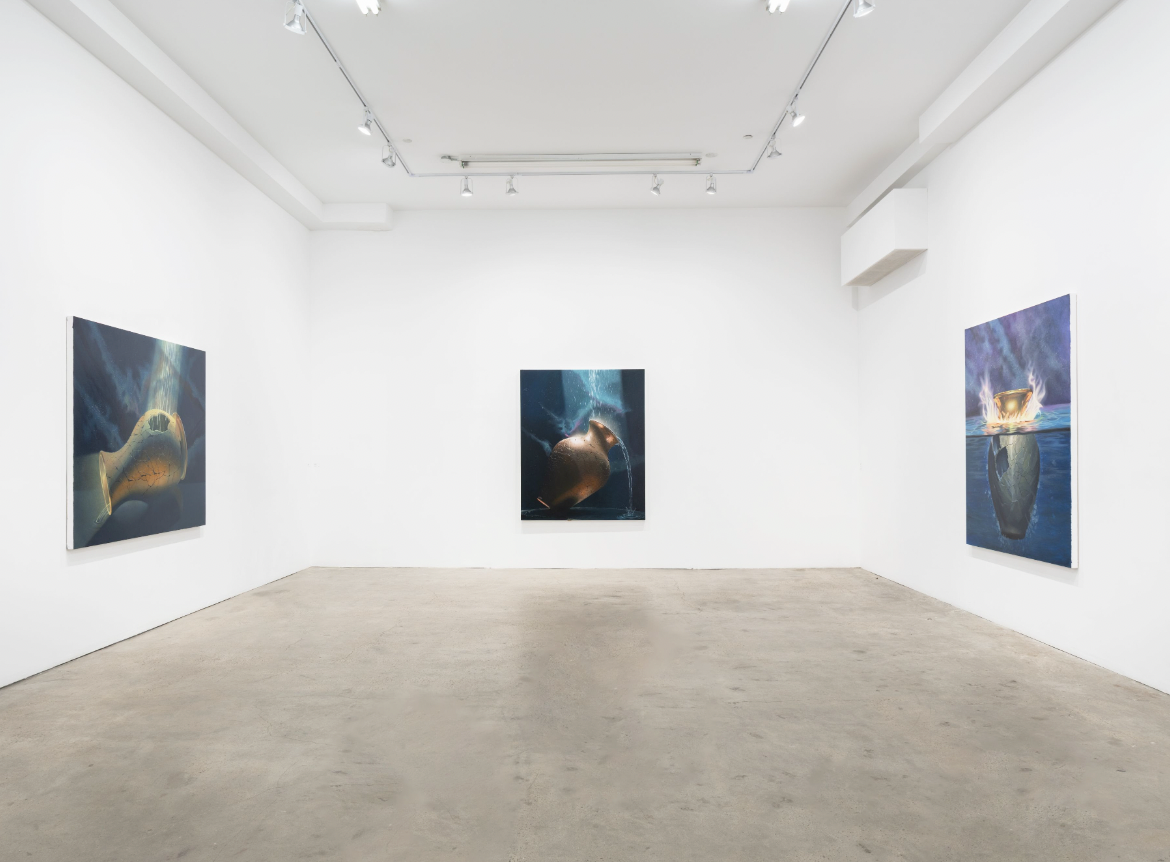
PLATO is honored to present Broken Vessels, a solo exhibition by Chicago-based artist Cindy Bernhard, featuring a new body of paintings that explores spiritual rupture, transcendence and the relationship between the human body and the divine. It will be on view in the gallery’s ground-floor space from June 4 through July 11.
At the center of the exhibition is the metaphor of the vessel: the body as a container for spirit and belief. Drawing from archetypal associations between gold and divinity, Christian mysticism and contemporary existential anxiety, Bernhard’s monumental six-foot paintings depict fractured golden forms that stand in for humanity itself — wounded, imperfect, yet still capable of transformation.
The exhibition emerged after what the artist describes as a profound spiritual awakening, an experience connected to the concept of the ‘Dark Night of the Soul,’ articulated by the 16th-century Spanish poet and theologian St. John of the Cross. During a period of emotional hardship, Bernhard underwent an intense feeling of joy and “unity with the cosmos.” “I was flooded with images of these gold vessels reminiscent of the body,” Bernhard explains. “Seven paintings representing the seven deadly sins, and one that stands for this feeling of wholeness.” The eighth painting, reminiscent of an overexposed photograph and devoid of the colorful exuberance that defines the others, was inspired by the Shroud of Turin, which many believe to be the burial cloth of Jesus.
Throughout Broken Vessels, the metal functions as both a spiritual symbol and cultural critique. Across civilizations, gold has signified enlightenment, sacred ritual and immortality — from Christian icons and gilded chalices to Tutankhamun’s funerary mask and the golden light of higher consciousness in yogic traditions. Bernhard places these associations against the backdrop of contemporary materialism, where greed, spectacle and the pursuit of power increasingly replace or corrupt spiritual inquiry.
The vessels themselves bear razor-thin fractures and weathered surfaces, referencing both bodily vulnerability and psychic erosion. Bernhard describes these cracks as “microfractures in our souls.” The relentless pace of the news cycle, political extremity and collective anxiety become invisible pressures acting upon the spirit. Despite this atmosphere of rupture, the paintings also suggest the possibility of redemption. Light, water, fire and smoke recur throughout the exhibition as symbols of purification and divine presence.
Technically, Broken Vessels marks a new development in Bernhard’s practice. The artist built luminous surfaces by preserving exposed areas of raw canvas beneath translucent glazes, allowing light to emerge through the paintings. The new sanding techniques and razor-incised fissures heighten the sense of fragility and wear. Inspired in part by filmmaker Terrence Malick and his juxtaposition of intimate human experience with cosmic imagery, Bernhard introduces constellations throughout the exhibition as reminders of humanity’s relationship to a larger universe.
The works embrace a distinctly contemporary visual language. Ultra-precise astronomical imagery fuses with the aesthetics of Hollywood cinema, music videos and digital effects — all rendered painstakingly through traditional painting techniques. Dramatic lighting, theatrical compositions and monumental scale recall Baroque painting while speaking to a contemporary moment equally shaped by excess and the search for meaning.
Broken Vessels invites viewers into a contemplative encounter with brokenness and the possibility of spiritual renewal. The exhibition asks what remains sacred in an age defined by spectacle, consumption and fragmentation, suggesting that transcendence can still perhaps emerge through the cracks.
_________________________________________________________________________________________
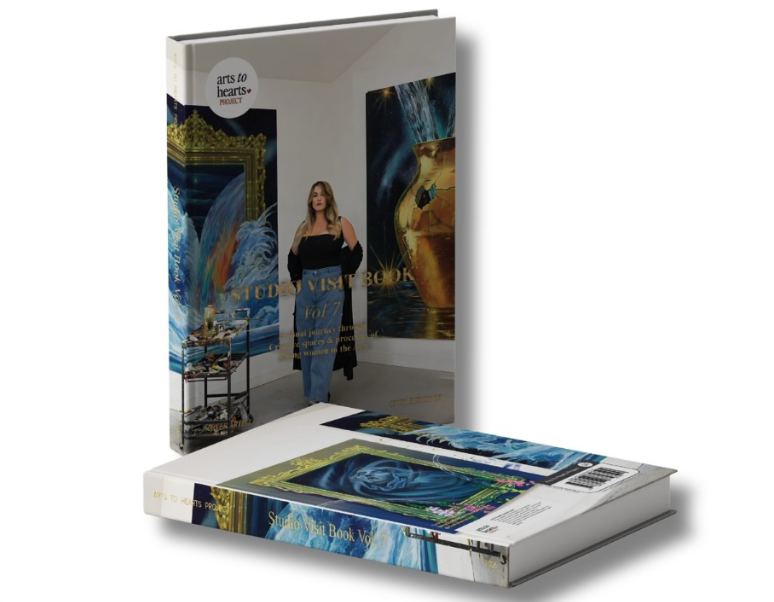
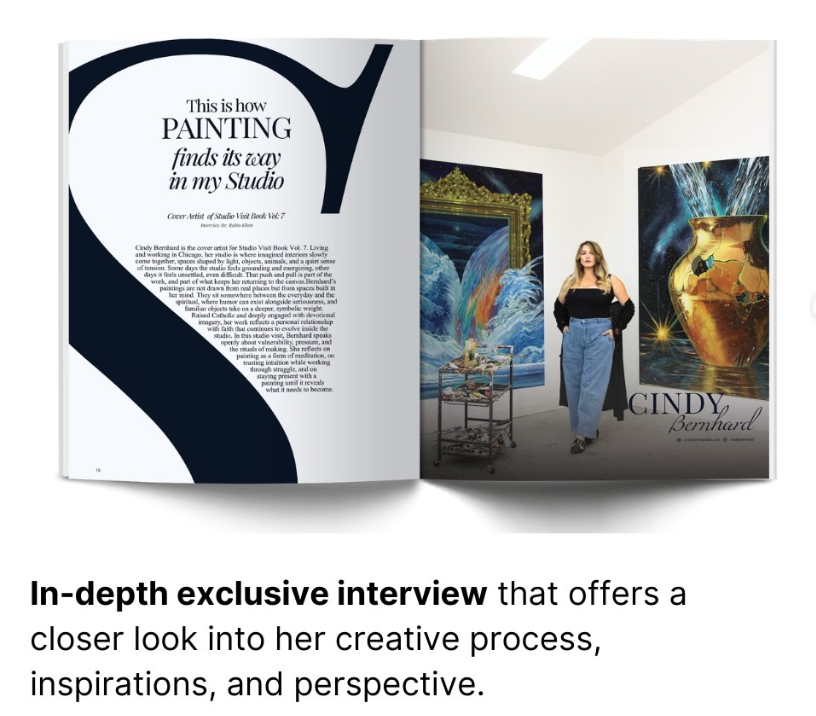
Spanning 250+ beautifully printed pages, this volume brings together the studios, stories, and voices of 50+ artists from around the world, offering an inclusive snapshot of contemporary art today.
Featuring a striking cover by Cindy Bernhard @cindybernhard with an exclusive interview.
Bound in a luxurious hardcover with gold foiling, Studio Visit Book – Volume 7 is made to be collected, gifted, and revisited.
Available now:
✨ Premium Collectible Edition — shop.artstoheartsproject.com
✨ Regular Edition — Barnes & Noble & Amazon
_________________________________________________________________________________________

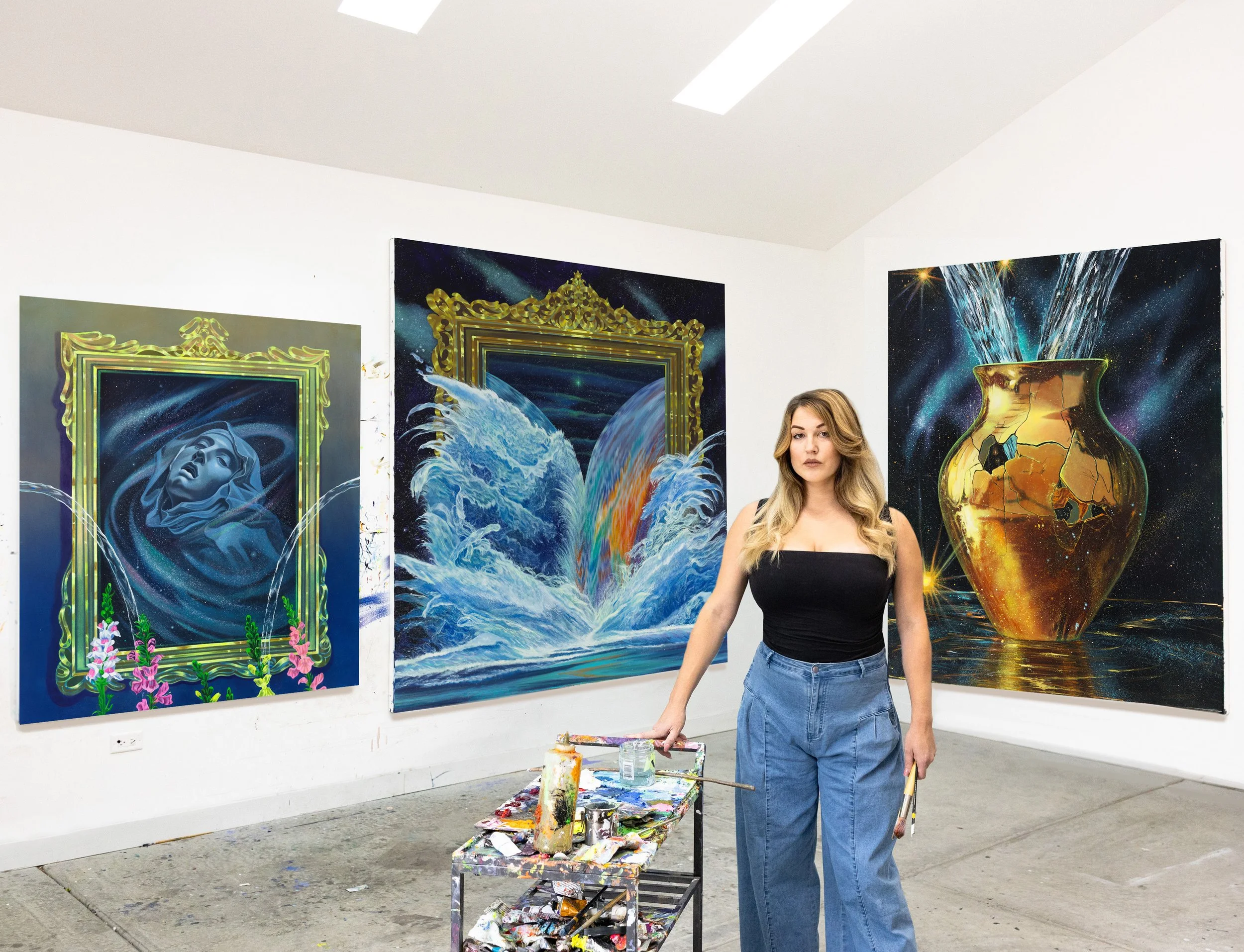
“Between the Neon and the Sacred: Inside the World of Cindy Bernhard”
Cindy Bernhard has long stood at the threshold between the visible and the unseen. Her paintings — shimmering with neon palettes, theatrical chiaroscuro, cats, mirrors, and devotional light — move fluidly between hyper-real precision and dreamlike mysticism. Over the years, Bernhard has built a singular visual language rooted in tension: humor and horror, innocence and drama, the earthly and the transcendent.
In this conversation, the Chicago-born artist reflects on the origins of her surreal sensibility, the slow evolution of her signature motifs, and the deepening spiritual dimension that now shapes her practice. Drawing on medieval iconography, digital aesthetics, and the visions of Catholic mystics, Bernhard speaks candidly about painting as meditation, ritual, and revelation — and about how her new series, When the Eternal Breaks Through, marks a pivotal expansion of her universe, both technically and symbolically.
Click here to read the full interview.
_________________________________________________________________________________________
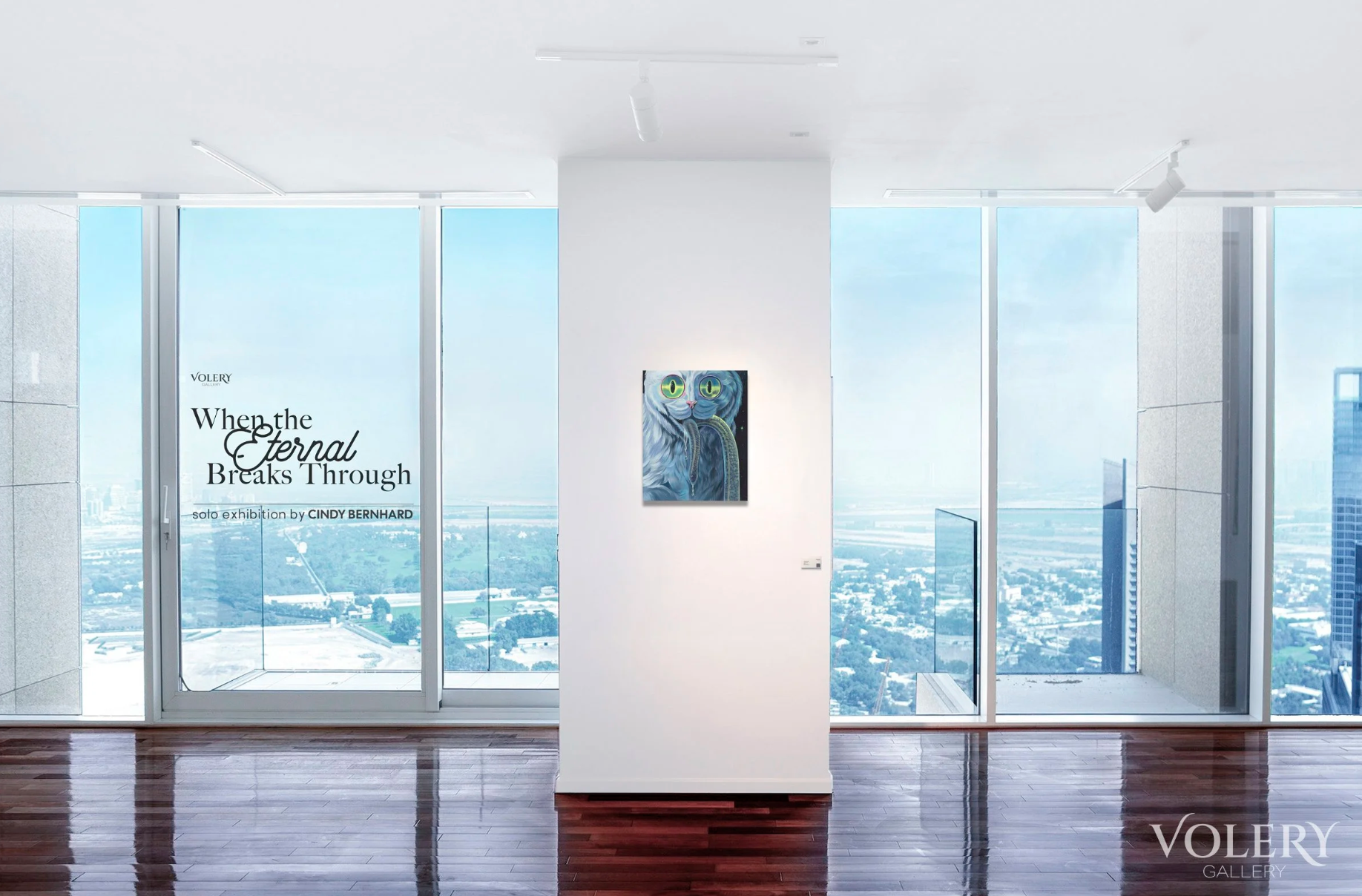
Volery Gallery is proud to present When the Eternal Breaks Through, a solo exhibition by Cindy Bernhard, opening on Wednesday, 3 December 2025, and on view until Tuesday, 16 December 2025, in Dubai. Known for her luminous, cinematic paintings that merge devotion and digital glow, Bernhard expands the boundaries of contemporary figuration, transforming light itself into both subject and atmosphere.
In this new body of work, Bernhard continues her exploration of surface as revelation, where paint radiates, refracts, and breathes. Each canvas becomes a threshold between the sacred and the screen, where baroque intensity meets the language of our hyper-mediated age.
When the Eternal Breaks Through, by Morgan Meis (abbreviated)
Bernhard is one of those painters for whom surface is both subject and stage. The surface, in her work, is not neutral ground; it’s alive. It glows, refracts, glimmers, and occasionally seems to breathe. The light in her canvases is a paint-born phenomenon; it doesn’t fall on the painting so much as emanate from it. In this, she’s closer to Helen Frankenthaler than to Richter, though her edge is sharper and her tone more cinematic. Frankenthaler once said, “The paint itself becomes the light, the atmosphere.” That could easily serve as an epigraph for Bernhard’s recent work, though with the caveat that the atmosphere here has weather: clouds, storms, water pressure, cosmic showers of phosphorescent rain.
Bernhard’s world borrows freely from the language of religious art. The framed, haloed faces; the liquid ecstasies; the flood of illumination breaking through the dark. This is religious painting reimagined through the glow of a screen. These paintings channel the devotional impulse without explicit doctrine. They feel like altarpieces for a secular age, where transcendence comes in the form of good lighting and perfect gradients. You could say they’re paintings of faith, with all the tension that the “of” here implies.
The gold frame seems to hover between kitsch and reverence, and that’s exactly the tension where the work lives. This is a world that takes the baroque’s obsession with spectacle and turns it inside out. Spectacle now becomes sincerity. The miracle is aesthetic: the paint performs transubstantiation. The paintings would look utterly at home on Instagram, and that’s part of the point. Bernhard understands that the spiritual arena of our time is the feed: a space of icons, radiant color fields, slow hypnotic motion. Her work meets that arena on its own terms, and yet exceeds it. On a screen these images might first register as digital, airbrushed, almost too smooth. In person, the craft asserts itself, the slight resistance of brushwork, the drag of the medium. You feel the body behind the glow.
The humor is important. Without it, the religiosity might fall flat. Bernhard’s paintings flirt with revelation, but they keep a wink in reserve. There’s something profoundly human in that mixture, awe and laughter, faith and camp. She knows that the divine can only survive if it also knows how to perform on the internet. What makes this humor work is her unrelenting precision. Every whisker, every droplet, every refracted line of rain, all executed with devotion. And that’s not the wrong word. Painting like this requires the devotional temperament. Each stroke is an act of worship, or at least of serious regard. She paints like someone who believes there’s still something in the world worth perfecting, even if only for a moment.
If Bernhard’s work is religious, it’s because it believes in the power of the visible. These paintings insist that light itself, made, faked, built up in layers of pigment, can still be an instrument of grace. The radiance is not metaphorical; it’s optical, real, there in the way paint interacts with our eyes and our brains. It’s religious spirituality for the digital age, slippery, pixelated, and impossible to pin down. That’s also what gives the paintings their strange purity amid the excess. Everything is slick, luminous, overripe, and yet nothing feels cynical. They operate in that narrow, nearly miraculous space where camp and sincerity touch fingertips. The same place, incidentally, where genuine faith lives.
Bernhard’s genius is to know that in painting, as in religion or spirituality of any kind, the trick is not to prove anything but to make you believe for a moment. To make you feel, standing before the image, that light and surface and color might, just this once, be enough.
_________________________________________________________________________________________


Track 1 (limited edition blend) artwork by Cindy Bernhard
_________________________________________________________________________________________

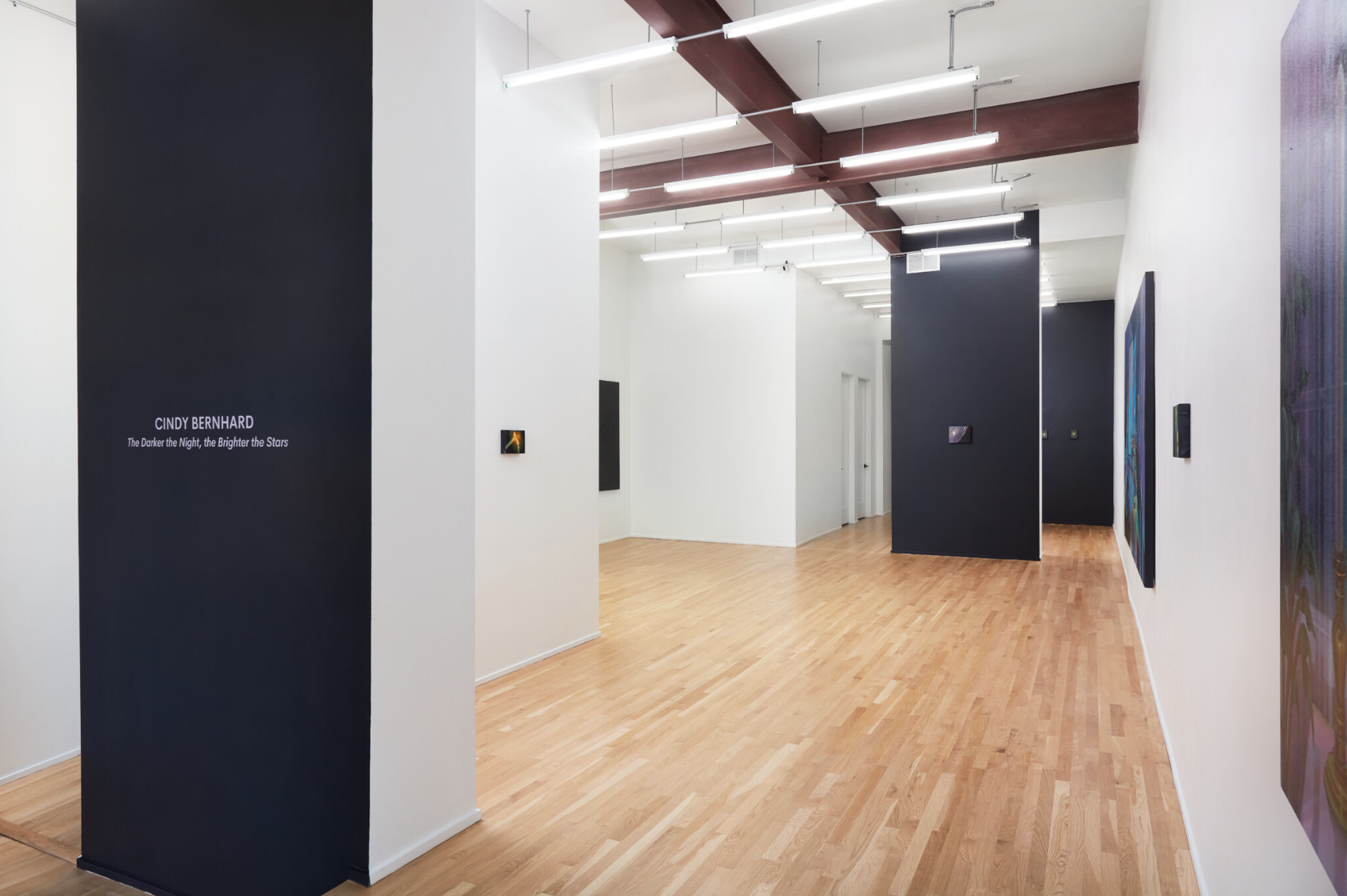
ANDREW RAFACZ is excited to announce The Darker the Night, the Brighter the Stars, a solo exhibition of new paintings from Cindy Bernhard, in Galleries One & Two. The exhibition opens Friday, November 1st and continues through Saturday, December 21st, 2024. This is the artist’s first solo exhibition with the gallery.
The Darker the Night, the Brighter the Stars presents a series of new oil paintings on canvas from Cindy Bernhard. Employing dramatic shifts between light and dark, ecstatic colors and mystical imagery, Bernhard creates her own fantastic, albeit representative world.
Referencing a line from Fyodor Dostoevsky’s Crime and Punishment, the title of Bernhard’s exhibition points directly to her ongoing investigation of mysticism and the search for truth by way of her own evolving spirituality.
At the center of the exhibition is The Dark Night of the Soul, a six by ten-foot painting set in an imagined version of the artist’s studio, titled after the 16th century poem of the same name by St. John of the Cross. The poem addresses a phase of passive purification of the spirit within mystical development. Colloquially, the phrase “dark night of the soul” is used to describe a crisis of faith or a difficult, painful period in one’s life.
The vibrant, layered scene contains several paintings-within-the-painting in varying stages of completion (a seemingly blank canvas capturing the shadows of the room, a completed one on an easel) as well as the artist’s tools of her work— tubes of paints, brushes, a palette and jars— on a table and a rolling cart. Two cats— stand-ins for human subjects— are engaged in mysterious and playful acts. Catching the drama of the studio in media res, the viewer is inundated in Bernhard’s familiar interactions between light and shadow, interior and exterior. Her meta-painting mise-en-scène recalls other historical paintings of self-reflexivity and reflection, such as Velasquez’ Las Meninas or Vermeer’s The Allegory of Painting. Although the artist is physically absent from the scene, her presence is undoubtedly felt.
Bernhard has also shifted scale with this exhibition, counterbalancing her largest work to date with her smallest. A series of intimately-sized canvases respond to the epic tableau of The Dark Night of the Soul with focused depictions of lit candles, caves, plumes of smoke, flowing water and vessels — imagery often found in her larger paintings but distilled here into an elemental language. Representing air, earth, fire and water, Bernhard focuses on these singular charged images, prioritizing a visceral sense of the primal and sublime in the everyday, which frequently defines the artist’s work. For Bernhard, it is an attempt to reset and get back to something more primary, both in her painting practice and her metaphysical pursuits.
_________________________________________________________________________________________

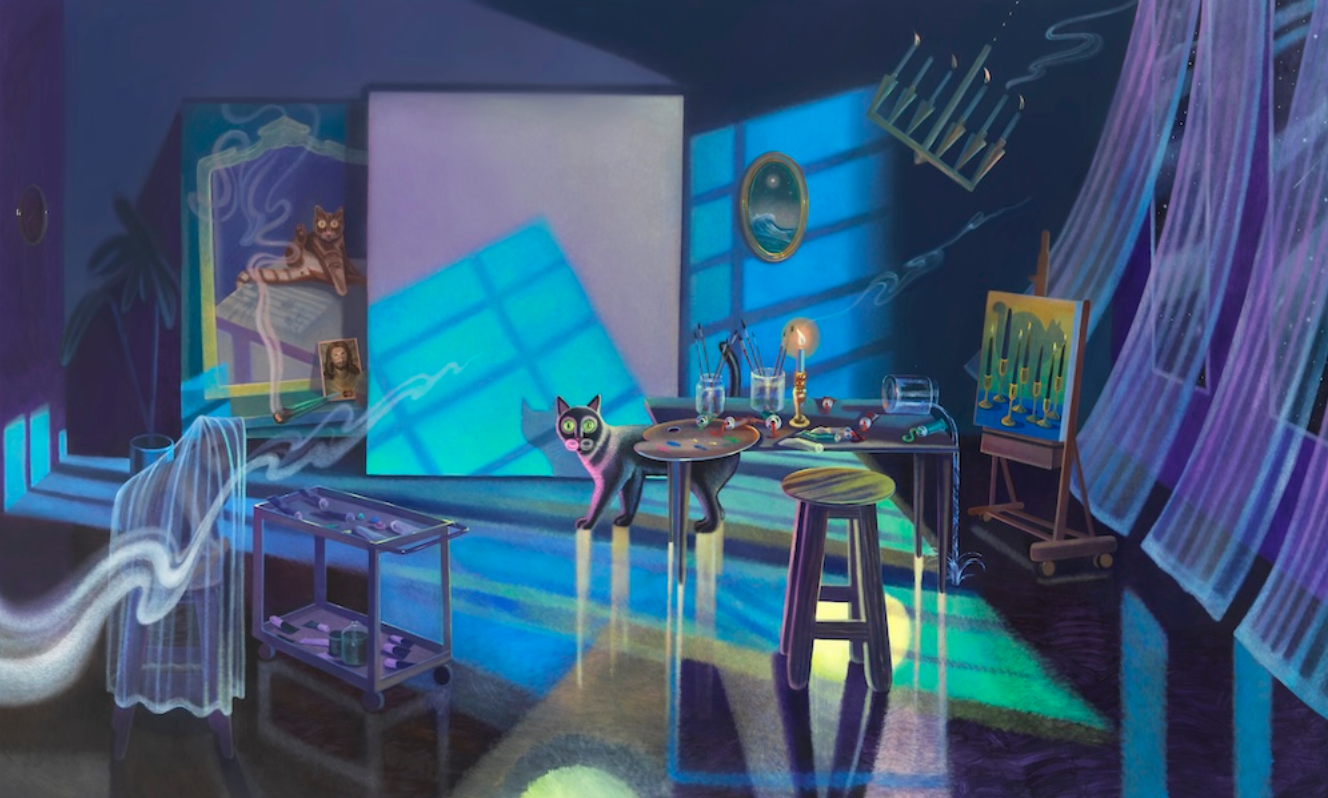
The Dark Night of the Soul, oil on canvas, 72 x 120 in, 2024

Trinity, oil on canvas, 60 x 90 in, 2024
“A Spiritual Cindy Bernhard in “The Darker the Night, the Brighter the Stars”
Maybe I'm stretching or maybe I'm right on point, but this is the perfect timing for a Cindy Bernhard show. Feeling as we are on the precipice of what is both a seimisic shift and yet the gut feeling that for 8 years now we have been on an anxiety-riddled precipice, Bernhard has gathered this sort of feeling and created sublime, personal paintings. The title of her show, The Darker the Night, the Brighter the Stars, a reference from Fyodor Dostoevsky’s Crime and Punishment, captures Bernhard's juxtaposition of mysticism and spirituality.
In the context of Crime and Punishment, this line captures a theme where suffering and hardship can lead to greater clarity, redemption, or understanding. The novel's exploration of morality, guilt, and the possibility of redemption amidst dire circumstances, we ain't really traveling far from the world we find ourselves in now. At the center of Bernhard's exhibition is The Dark Night of the Soul, "a six by ten-foot painting set in an imagined version of the artist’s studio, titled after the 16th century poem of the same name by St. John of the Cross," who himself was a a Spanish mystic, poet, and Roman Catholic saint, who emphasized the importance of surrender and detachment from worldly desires in order to achieve spiritual enlightenmen, thus having a profound influence on Christian mysticism and spirituality.
There are a lot of elements at play in Cindy's work but mainly we are looking at growth, something greater amongst the surface level. She balances her larget works to date with some of her smallest. It's a journey, and we are here for it. —Evan Pricco
Click here to read the full article.
__________________________________________________


“Cindy Bernhard Takes Us to Church”
‘When Cindy Bernhard found the cats she found herself. That is the short summary of the story. During the pandemic, and years of trying to find her artistic voice, Chicago-based Bernhard painted a cat in her work and found that voice, that direction, that narrative, the character that was her but also something so universal. The cats aren't just lying about, they are sleekily wandering beautiful rooms, hiding behind beautiful objects, with candles and purple and the night as the backdrop. They are inquisitive and curious, much like Bernhard herself.
On the eve of her solo show Take Me to Church at Richard Heller Gallery, Radio Juxtapoz sat down with Bernhard to discuss religion, growing up on a farm, a brief move to Los Angeles, finding a home in Chicago and how the cats and the candles made it into her work.’
Click to listen to Radio Juxtapoz, Episode 139, Cindy Bernhard
_________________________________________________________________________________________

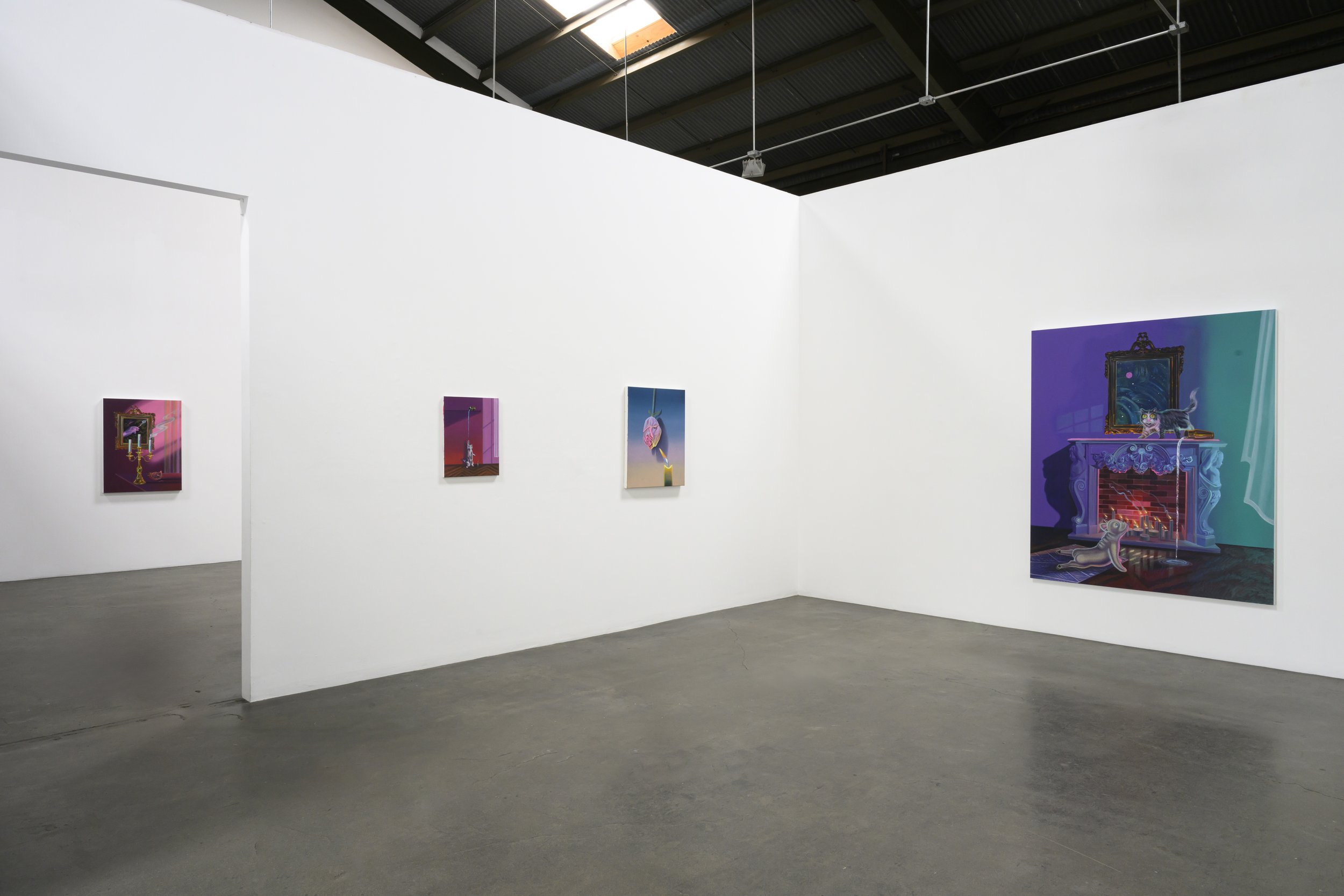
In this new body of work, Bernhard embarks on a symbolic search for truth in the spiritual and mystical world. Employing minimally decorated domestic interiors as settings for the dramas of human existence, the works are full of heightened tensions and sometimes comedic relief.
Bernhard’s animals are stand-ins for humans. Dogs practice yoga in a search for spiritual transcendence, a longing for quietness of the mind. The works often depict moments frozen in time before something happens. For example, the moment before fire from a candle is blown out or the moment right after a vessel is knocked over and water pours out.
Bernhard is inspired by Terrence Malick films and his non sequitur cinematography of intimate conversations between two people juxtaposed with images of the universe. Bright colors are used to heighten idea of something that is of this world, but dreamlike, surreal or in a heightened state of mind.
Bernhard’s paintings explore altered states and mysteries through carefully placed and arranged numinous objects. Equally influenced by historical religious art and contemporary movements, these works are a synthesis of the artist’s longing for understanding and spiritual awakening.
_________________________________________________________________________________________

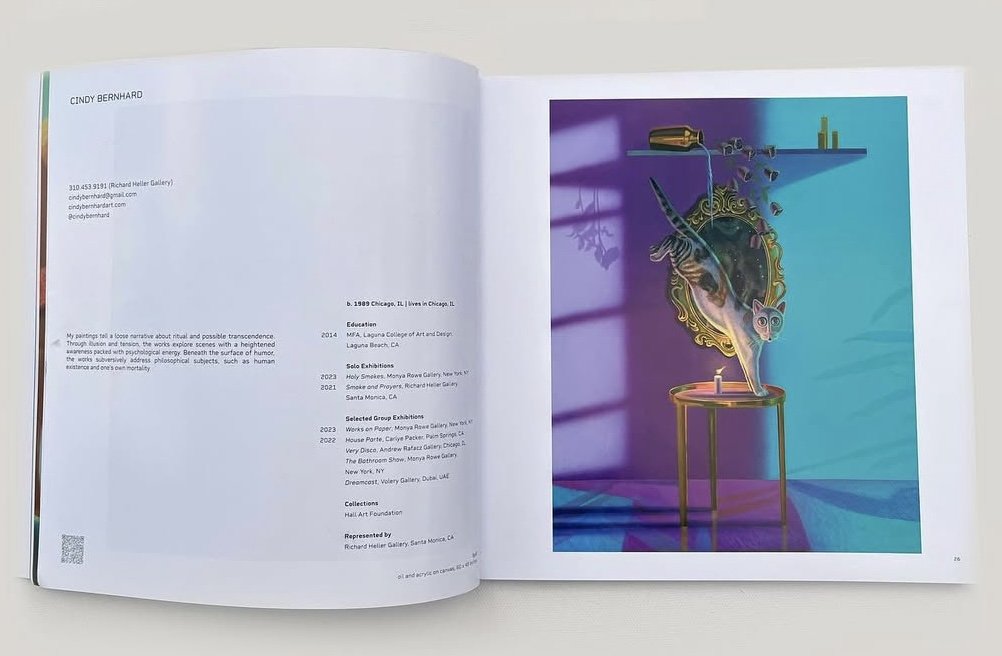
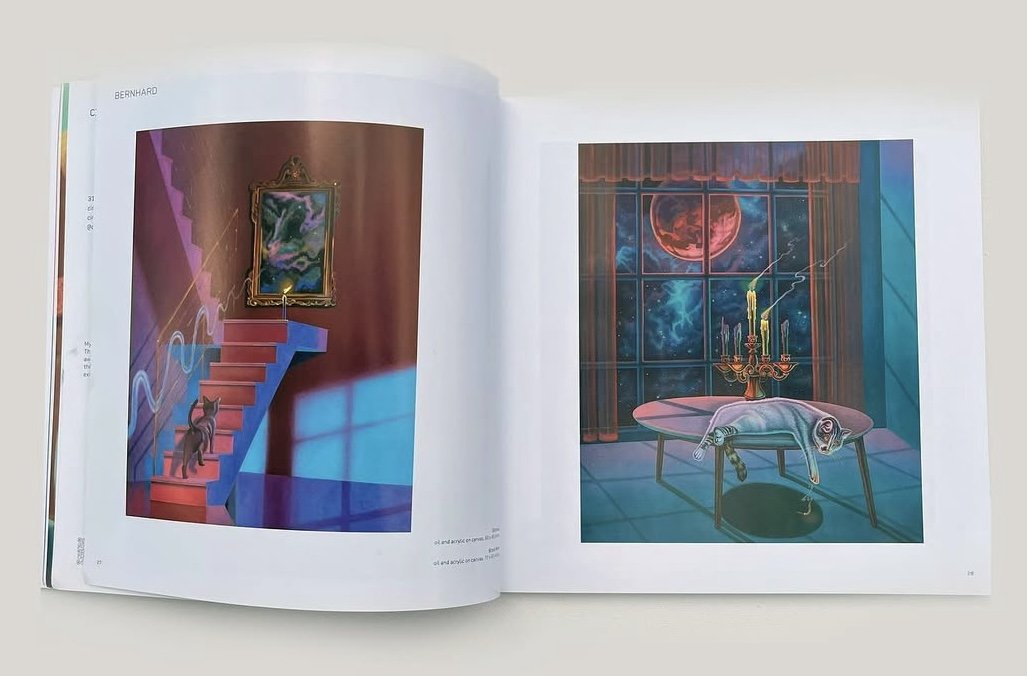
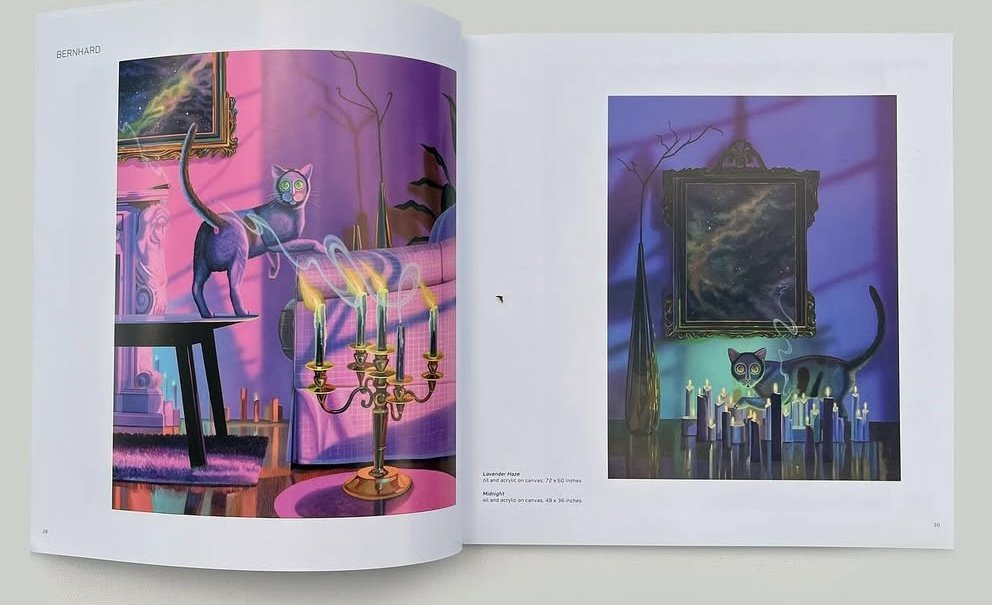
New American Paintings, Issue 167 , cover artist
‘One of the Chicago-based artists featured in this issue is painter Cindy Bernhard. I first encountered her work in a small group show several years ago, although she first began exhibiting in 2010. In the past two years, interest in Bernhard’s practice has taken a dramatic upswing; as I write these words, her work is the focus of a successful solo exhibition at Monya Rowe Gallery in New York City.
There is a lot of window dressing in the art world, but, ultimately, the work is the most important element. Artists must have not only ideas worthy of exploring but also the technical and conceptual abilities to generate meaningful content from those ideas; simply put, the work needs to be “there”.
For artists such as Bernhard and many others, the timing is precisely right; and what they have to say is presently relevant. I don’t think you can force this in any art form…sometimes the world is ready for your vision and sometimes it is not. I am a big believer that if an artist’s practice is significant, the world will catch up.’
Steven Zevitas, Publisher and Editor
Click here for more information.
_________________________________________________________________________________________

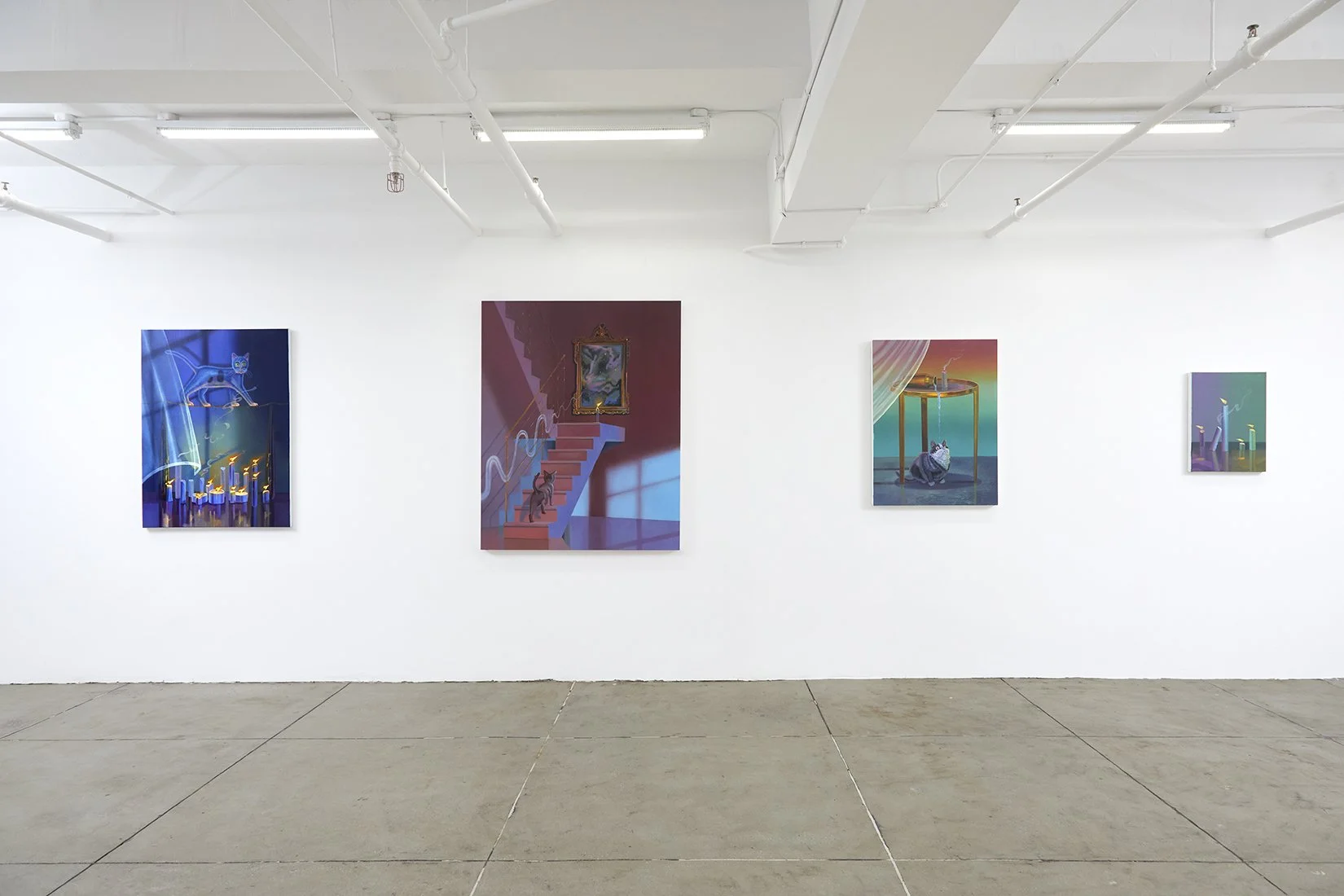
CINDY BERNHARD Holy Smokes May 4 - June 9, 2023 Opening reception: Thursday, May 4, 6-8 PM
Monya Rowe Gallery is pleased to present an exhibition of new paintings by Cindy Bernhard, the artist’s first exhibition with the gallery and in New York. The opening reception for the artist will be held on Thursday, May 4, 6-8 PM. This is the inaugural exhibition in the gallery’s new location. The gallery is located in the same building on a different floor, new suite #304.
In this exhibition, featuring small to large scale works, Bernhard continues to incorporate her signature imagery of candles, mirrors, cats and smoke. In Stairway (2023), a cat ascends a staircase in a trance-like state toward a burning taper candle. The candle is situated on the landing of the staircase in front of a gilded mirror adorned with smoke patterns and the appearance of a portal leading to a night-time sky replete with stars. The ornate mirror is in stark contrast to the austere minimalist surroundings suggestive of a modern city apartment. The cat appears to be spiritually led to this mysterious make-shift alter. Bernhard uses animals as humorous stand-ins for people. The cats depicted may appear startled or surprised when looking outside the picture plane, which forces the viewer to confront the protagonist and alludes to an otherworldly presence.
For Bernhard, growing up Catholic imbued an inherent affinity for religious imagery associated with the Church, such as gold relics, a plethora of candles, large statues, and Gothic sensibilities. The work hints at rituals, spirits and mystical experiences.
Bernhard’s stylized paintings use shadows to suggest the passage of time and light while imbuing each painting with atmosphere and feeling. Through illusion and tension, the work explores scenes with a heightened awareness packed with psychological energy. The artist uses humor and an eye-catching candy-like palette to further draw the viewer into each quiet scene. Beneath the surface humor, the work subversively addresses philosophical subjects such as ones’ own mortality and human existence as a whole.
_________________________________________________________________________________________


Stairway, oil on canvas, 60 x 48 in, 2023
“Cindy Bernhard is all about Holy Smokes and a lot of Cats”
In this exhibition, featuring small to large scale works, Bernhard continues to incorporate her signature imagery of candles, mirrors, cats and smoke. In Stairway (2023), a cat ascends a staircase in a trance-like state toward a burning taper candle. The candle is situated on the landing of the staircase in front of a gilded mirror adorned with smoke patterns and the appearance of a portal leading to a night-time sky replete with stars. The ornate mirror is in stark contrast to the austere minimalist surroundings suggestive of a modern city apartment. The cat appears to be spiritually led to this mysterious make-shift alter. Bernhard uses animals as humorous stand-ins for people. The cats depicted may appear startled or surprised when looking outside the picture plane, which forces the viewer to confront the protagonist and alludes to an otherworldly presence.
For Bernhard, growing up Catholic imbued an inherent affinity for religious imagery associated with the Church, such as gold relics, a plethora of candles, large statues, and Gothic sensibilities. The work hints at rituals, spirits and mystical experiences.
Bernhard’s stylized paintings use shadows to suggest the passage of time and light while imbuing each painting with atmosphere and feeling. Through illusion and tension, the work explores scenes with a heightened awareness packed with psychological energy. The artist uses humor and an eye-catching candy-like palette to further draw the viewer into each quiet scene. Beneath the surface humor, the work subversively addresses philosophical subjects such as ones’ own mortality and human existence as a whole.
Click here to read the full article.
__________________________________________________

Artnet - Dealer Monya Rowe on the ‘Naivete and Chutzpah’ That Has Made Her New York Gallery a Standout for 20 Years
“Holy Smokes,” an exhibition of works by artist Cindy Bernhard, inaugurated in the new venue. Bernhard’s iridescent, nocturnal paintings have something aptly ceremonial about them—the saucer-eyed cats with shiny, thick coats that haunt these canvases are accompanied by luminous mirrors seemingly plucked from fairy tales, as well as glowing candles, that are seemingly metamorphic in their melting forms. One could imagine the show as a kind of ritual mass, blessing the space.”
Click here for more information.
_________________________________________________________________________________________


New York Magazine - The Approval Matrix
Click here for more information.
_________________________________________________________________________________________


Broccoli Issue 16
Click here for more information.
_________________________________________________________________________________________


___________________________________________________________________


Maake Issue 13 Curated by Tyler Lafreniere
Click here for more information.
_________________________________________________________________________________________


London Paint Club “Our Top 10 Paintings from NADA New York
Click here for more information.
_________________________________________________________________________________________


Cindy Bernhard’s “Smoke and Prayers” is on View at Richard Heller Gallery —by Shawn Ghassemitari
“Spooky dreamscapes that invite us to slow down.
Cindy Bernhard is a Chicago-based artist with a spooky aesthetic. Working across mediums, such as air-brushed veneers, oils and pastels, she creates superflat dreamscapes that invite us to slow down and take in the peculiarities of daily life.
Bernhard has just unveiled a new solo exhibition entitled, “Smoke and Prayers” at Richard Heller Gallery in Santa Monica. Quickly one can detect the artist’s penchant for humor and irony through symbolic juxtapositions, such as those used in her painting, Joints and Jesus. “This structure allows me to access viewers through empathy and humor,” said Bernhard in a past statement. However, the artist does not use humor simply as comedy relief, but rather as a “political response and act of resistance to pop culture’s demanding aesthetics,” she added.” —Shawn Ghassemitari
Click here to read the full article.
_________________________________________________________________________________________


Cindy Bernhard’s “Smoke and Prayers” @ Richard Heller Gallery, Santa Monica —by Gwynned Vitello
“Cindy Bernhard paints smoke and mirrors, and we love the clever deception. Welcome to her world of super-flat pictures and air-brushed veneers, then swim into those ombre gradations of pastel hues and dive into the dreamscapes. Raised on a hog farm in rural Illinois and now calling Chicago home, as student, studio assistant and teacher, she makes her magic with a wealth of perspective. Bernhard’s seamless depictions of the duality of life, sly humor and satiny sense of color invites viewers to slow down and embrace the wonders of life, including the delicious irony. She has painted mysterious rooms and hallways, but maybe her favorite ciphers are dogs and cats.
“This structure allows me to access viewers through empathy and humor. I use humor not merely as relief, but also as a political response and act of resistance to pop culture’s demanding aesthetics.” Bernhard’s first solo exhibit, Smoke and Prayers, wafting in a slow simmer of reflection and the crackle of humor that ignites all of her paintings, opens in September at Santa Monica’s Richard Heller Gallery. Just as smoke is the transition of matter into spirit, Joints and Jesus is a prayerful and playful appreciation of life, “visual poems,” as she calls them—whether or not you’re a cat person.” —Gwynned Vitello
Click here to read full article.
_________________________________________________________________________________________

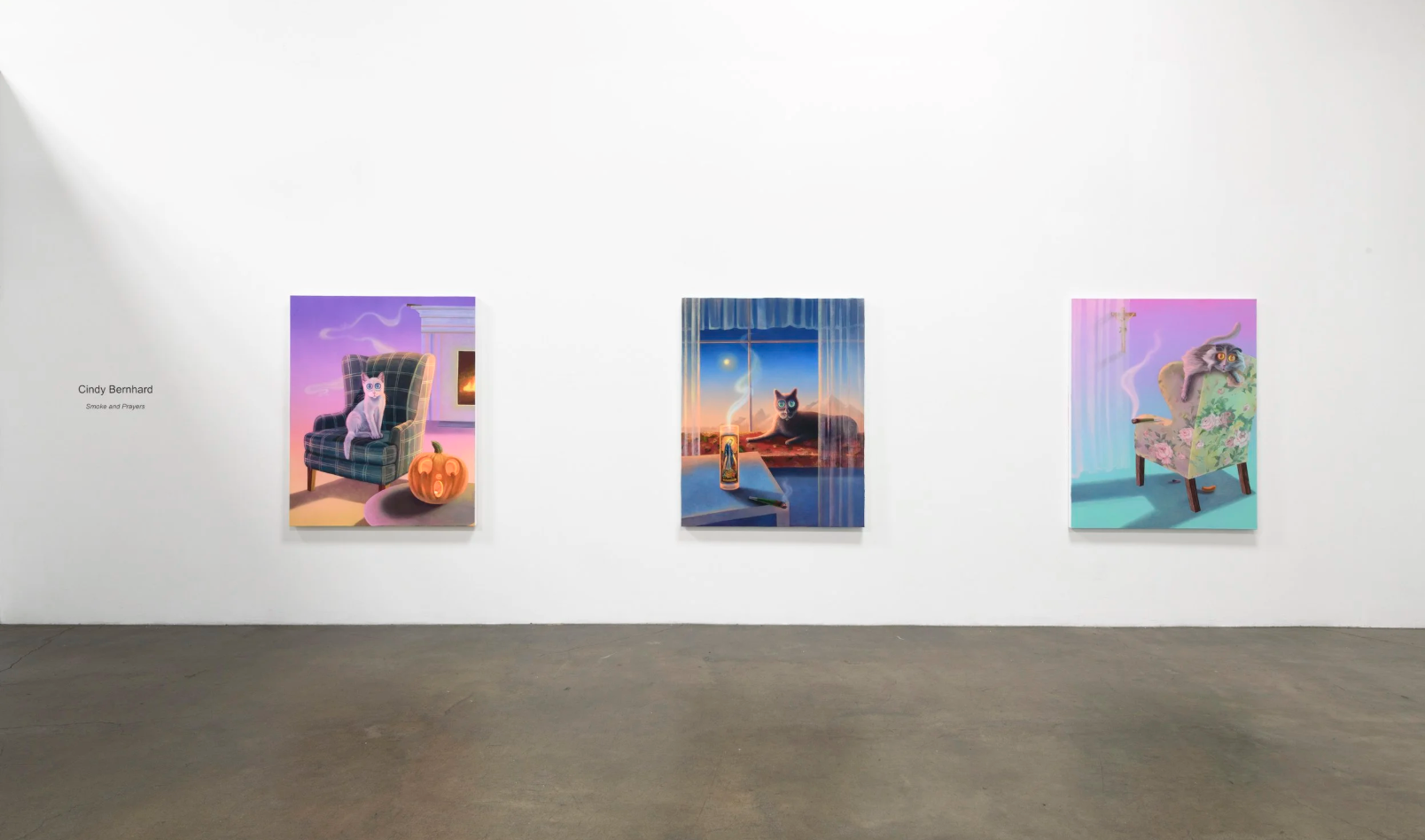
Richard Heller Gallery is pleased to announce its first solo exhibition with Chicago-based painter, Cindy Bernhard —by Morgan Meis
"What can painting still do in 2021, you might ask. At the hands of Cindy Bernhard, almost anything. Bernhard, like all true painters, is in love with the pure sensuality of pigments, the visceral effects of paint upon the canvas. You see this in the stunning color of the paintings, but also in the patterns and shapes.
Joints and Jesus (2021), at first appears to be a cute and cheeky portrayal of a cat captured in an act of genital licking through the reflection of a mirror on a mantelpiece. It's a clever painting within a painting, a trope you might find in Van Eyck or Vermeer. It is only with further reflection (pun intended) that we realize this is an altarpiece. The smoke of the “holy incense” is provided by a joint smoldering at the center of the picture.
Another startled cat, this critter with one blue and one yellow eye, meets our gaze in Momento Mori (2021). The joke here is that it's the joint that's died, the head of which has fallen from the table and is burning out on the beautifully painted carpet beneath. The cat alerts us to the problem, made all the more dire by the amusing presence of a classic memento mori skull at the far end of a pastel blue table. But you might also argue that the real memento mori in this picture is the pink butthole of the startled cat. That's to say, this is a painting of dualisms, of the dark that always comes with the light, of the corruption at the heart of all beauty, of the inevitable passing away of all that seems vibrant and new.
The paintings of Cindy Bernhard are veritably crackling with tensions, with a palpable sense of mystery that is all the more delectable for being suffused with such a lightly and confidently wielded wit and charm. You're struck initially by these paintings because they are daring and fresh and a treat for the eye. You stay with them because they are genuinely deep." —Morgan Meis
_________________________________________________________________________________________

Meet the Maker Cindy Bernhard—by Kelsey Ogletree

___________________________________________________________________
Smoke and Prayers @ Richard Heller Gallery —by Peter Frank
“Cindy Bernhard’s glowing, charming, witty, slightly spooky, knowingly corny pictures are a good foil for Sasha Pierce’s jagged, rhythmic abstractions, and vice versa. Torontonian Pierce actually imbues her fierce structures with the same tenebrous luminosity as Chicago-based Bernhard gets from her limpid sunsets and cozy, incense-stick-lit interiors. Pierce’s secret sauce is her engagement of traditional Japanese patterning, or Wagara. Bernhard’s is those cartoony cats whose saucer-wide eyes recall Margaret Keane and ‘60s kitsch. The energy flow between the two highly crafted exhibitions is as smooth as it is powerful.” —Peter Frank
__________________________________________________

60wrd/min COVID Edition: Cindy Bernhard —by Lori Waxman
“A recent study confirmed that watching internet videos of cute animals can reduce anxiety. Where does that leave painting? If the iridescent, pet-filled canvases of Cindy Bernhard are any indication, the medium holds up just fine. Bernhard makes mostly large, complex oil pictures with the compositional care of a Dutch Renaissance interior scene and the style sense of a millennial crafter. Like in Photoshop or an iPhone screen, everything is super-flat; backgrounds come in shades of airbrushed rainbow gradient; decorative patterns are infinite and overlapping; eighties chic is apparent and unstoppable; aspirational marble table tops make their de rigueur appearance. Living amid these Instagrammable scenes are curious orange tabbies, adorable wrinkly pugs and plenty other breeds of small pet, lounging on special pillows, staring out from framed photos and, in the case of one cat, showing its little pink butthole. Being of Generation X, some of these juxtapositions confuse my native ability to recognize kitsch and deal with it ironically. I realize, however, that this is my problem, and that it is probably getting in the way of some much-needed stress relief.” —Lori Waxman
Click here to read full article.
_________________________________________________________________________________________
Cindy Bernhard @ Shelter In Place Gallery


“Who's ready for some closeups?! One of my favorite aspects of these paintings is that the directionality of light in them mimics the light in the gallery, creating a further sense of depth and layered intricacy. They are windows upon windows, digging further into the domestic space within the bounds of the canvas. The duel flattening of the perspective while elongating the field with light is both visually confusing and exciting. And who can say no to candy corn and blunts on the porch?” —Shelter in Place Gallery
Click Here for more information on Shelter In Place Gallery
_________________________________________________________________________________________
New American Paintings - Cindy Bernhard Editor’s Pick of The Day

_________________________________________________________________________________________

Art Top 5: October 2019 —by Kerry Cardoza
Newcity named “Terrain Biennial” as one of the top 5 exhibitions to see this October.
Click here for full article.

_________________________________________________________________________________________

Skin Deep: A Review of Serious Vanity at One After 909 —by Chris Miller
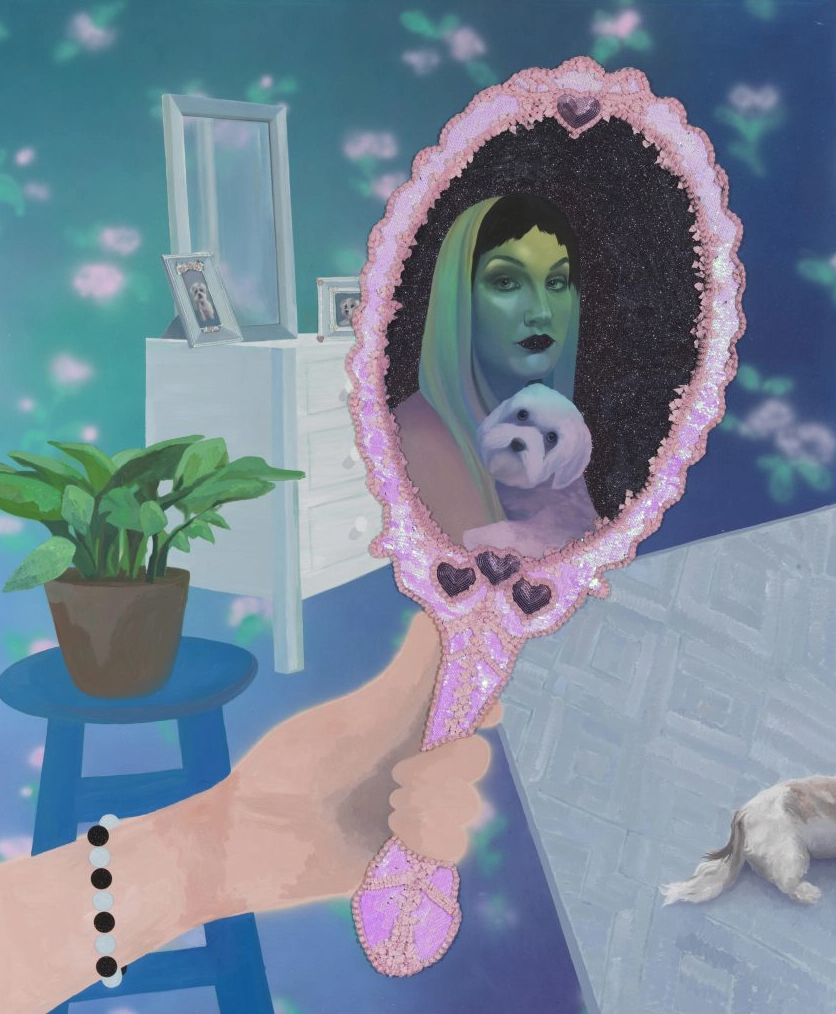
“Serious Vanity,” the title of this three-woman show, refers mostly to its outstanding painting, “Mirror Mirror,” by Cindy Bernhard (born 1989) which portrays Snow White’s stepmother as she studies her face in a late-Rococo-early-Walmart vanity mirror. The green pallor tells us she is jealous, the arched eyebrows tell us she is haughty, the cold stare tells us she is cruel. But what about those cute puppies? They’re in her arms, on her bed and enshrined in framed portraits on her dresser. And what about that low-rent dresser and the queen’s humble headscarf? She’s not really a queen at all—just an ordinary white girl who wants to be loved and is anxious about her status in the kingdom. The narrative quotes a melodramatic fairy tale, but is much more ambivalent about good and evil. The image resembles a Disney animated character, but the painting transcends the tacky craft-store materials that were used in its fabrication. There’s at least as much pathos here as bathos. Rather than hating on the evil queen, we might empathize with those conventional women who feel compelled to compete for value in the eyes of the world.
As the three artists borrow from popular culture to mock and critique social conventions, they fit well within the fifty-year tradition of Chicago Imagism. They’re the smart-ass kids who don’t accept the brain-dead conventions of the adult world. Sensitive design and skillful use of materials proves their serious intent. So does the sense that all three are expressing the reality of their own lives. Just don’t look here for the rapturous visuality that might validate a gender identity rather than just critique one. (Chris Miller)
Click here for full article.
_________________________________________________________________________________________

BAD AT SPORTS Top Weekend Picks (7/18 - 7/24)
BAD AT SPORTS blog featured Serious Vanity at One After 909 as a top weekend pick.
_________________________________________________________________________________________

‘Cindy Bernhard - Calling Attention To Illusionistic Form’ —by Chester Alamo-Costello.
“Cindy Bernhard is in the process of establishing a solid foundation in her painting career. Through addressing topical content and experimentation, she has built a series of works that offer insight into contemporaneous modes of self-portrayal by way of humor, illusion, symbolism, and tactile technique. This week the COMP Magazine took the Rock Island Metra down to Beverly to discuss with Bernhard the role art played in her youth, why painting is her medium of choice, the various techniques she employs to create illusion on a 2-dimensional surface, and her role as educator.” —Chester Alamo-Costello
click here for full article.
_________________________________________________________________________________________
